Non-Fiction Book Review - 'Defenders of the West' by Raymond Ibrahim
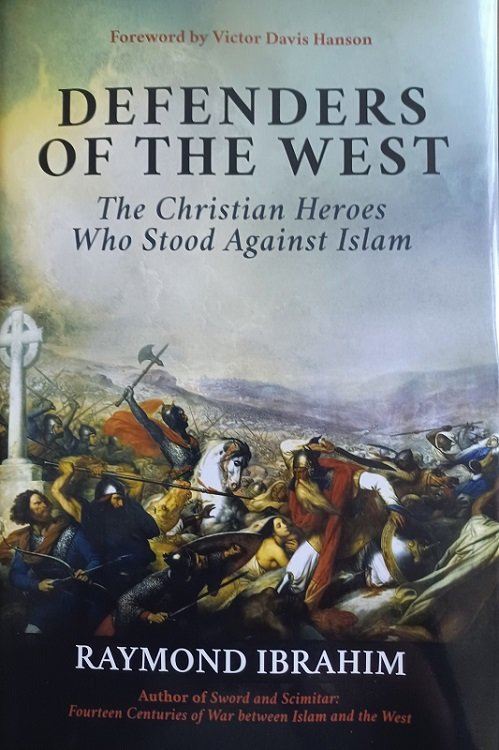
‘Defenders of the West’ by Raymond Ibrahim book cover
As promised, here is the long overdue review.
I finally read this book at the end of last year, but still being in the early stages of recovery, wasn’t ready to do any kind of blogging.
‘In Defenders of the West, the author of Sword and Scimitar follows up with vivid and dramatic profiles of eight extraordinary warriors – some saints, some sinners – who defended the Christian West against Islamic invasions. Discover the real Count Dracula, Spain’s El Cid, England’s Richard Lionheart, and many other historical figures, whose true and original claim to fame revolved around their defiant stance against jihadist aggression.’
Whereas ‘Sword and Scimitar’ was about decisive battles, this is about the decisive men who fought them.
In an interview, which I’ll link below, Raymond Ibrahim explained the reason he wrote this book: “I think there’s a great void in Western culture when it comes to finding heroes or… men of valour, men who were decisive, men who believed in something to fight and die for.”
He always emphasises checking primary sources and, from his college days, he’d already begun noticing the disconnect between what the primary sources said and what modern day historians claim.
In his books, he says probably about “a third of the entire text is actual quotes… I do that by design because it’s not about what I think, I want people to see what was said historically from the people who lived, fought, and died in those days.”
He draws on both Christian and Muslim sources, despite the latter’s very different outlook, to present a fair and balanced view.
I like that he credits his readers with having the intelligence to draw their own conclusions instead of insisting you agree with his opinion.
The book is laid out in eight chapters, one defender per chapter, in chronological order.
Chapter 1 – Duke Godfrey: Defender of Christ’s Sepulchre
Chapter 2 – The Cid: Lord and Master of War
Chapter 3 – King Richard: The Lion that Roared at Islam
Chapter 4 – Saint Ferdinand: Saviour of Spain
Chapter 5 – Saint Louis: Christ’s Tragic Hero
Chapter 6 – John Hunyadi: The White Knight of Wallachia
Chapter 7 – Skanderbeg: The Albanian Braveheart
Chapter 8 – Vlad Dracula: The Dread Lord Impaler
I was aware of six of these men, some more than others, but had never heard of John Hunyadi and Skanderbeg.
In the Introduction, Ibrahim writes, ‘… irrespective of what any professional historian thought, the eight men… were for centuries held… as iconic exemplars of heroism and self-sacrifice; today, however, they are largely seen by their Western descendants as embarrassments – exemplars only of the patriarchy, “toxic masculinity,” xenophobia, and, of course, “racism.”’
Ibrahim talks about ‘Just War’ theory, quoting Saint Augustine: “It is the injustice of the opposing side that lays on the wise man the duty to wage war.”
For each man, Ibrahim first gives the background and the state of their country leading up to their birth, a brief mention of their childhood, with most of the chapter given over to their decisive exploits, ending with the circumstances leading to their deaths.
The following passages about Duke Godfrey give an idea of how Ibrahim weaves the primary sources, which I’ve highlighted in bold, into his narrative, while also demonstrating the disconnect between reality and the way modern historians and the media paint these Christian men, as degenerate and cowardly.
Godfrey of Bouillon, ‘the Duke’, the second of three sons, was born around 1060 in what is ‘now part of north-east France or Belgium’ and was ‘maternally descended from Charlemagne and Charles “the Hammer” Martel’.
He was thirty-five years old in 1095 when Pope Urban II ‘called for what came to be known as the First Crusade’; Godfrey and his brothers were ‘among the first nobles to take the cross’.
Prior to leaving, the three brothers made generous donations to churches and religious houses and, ‘to help fund their Crusade, they sold or mortgaged much of their lands and properties, often cheaply’; they did this ‘“moved by the hope of an eternal inheritance and by love, [and] are preparing to fight for God in Jerusalem…”’
In August 1096, along with other ‘“great and distinguished men”’, Godfrey set off, leading ‘eighty thousand Crusaders’ and also monks who, ‘“at the regular hours… celebrated the divine offices for him…”’
Godfrey was the first to leave Constantinople for Asia Minor, ‘which for decades had been ravaged and conquered by the Turks’, landing in Nicomedia in May 1097 where he and his men were greeted by an appalling sight – a literal mountain of ‘“the bones and decapitated heads of the participants of the People’s Crusade – peasant men, women, and children who had impatiently crossed into Anatolia… [the Turks] had ruthlessly… slaughtered them.”’
No doubt, this fuelled the Crusaders’ resolve to fight for and free their Christian brethren.
The Crusaders first besieged and liberated Nicaea, then continued to Antioch where the siege lasted seven long months before they liberated it only to find themselves besieged by a newly-arrived Muslim army; brought low by starvation, still the ‘outnumbered and weakened’ knights fought and won in June 1098.
Despite having been severely wounded defending a pilgrim from what locals had confirmed to be a man-eating bear, and suffering a ‘“serious illness”’ which had resulted from his wounds, Godfrey fought valiantly alongside his men at Antioch, managing to ‘“cut off many heads…”’, and ‘“performed there a famous deed worthy of remembrance forever”’; honestly, that deed has to be read in its entirety to fully grasp what he did.
Early 1099, Godfrey was once again the ‘first of the major leaders to resume the Crusade’ to Jerusalem with only ‘twelve hundred knights and twelve thousand infantry…’
Many of the Crusaders had endured two years of suffering, though Godfrey had suffered three for he’d been one of the first to set out, and the sight of Jerusalem, which they reached in June 1099, filled them with such emotion that ‘“Strong, stalwart men… sobbed aloud; some cast themselves upon their knees in prayer; others kissed the earth on which they stood…”’
They wasted no time in setting to work to blockade the city, but their numbers were too few for such work and many were killed in the unforgiving heat and lack of water.
But reinforcements and supplies arrived, and they spent three weeks ‘building the necessary siege equipment’.
The fighting, when it began, ‘“was persistent and terrible beyond belief.”’
When the walls were finally breached, ‘“Everywhere was frightful carnage…”’
Godfrey’s focus was not on any spoils but to exact revenge ‘“for the blood of the servants of God”’, and he did this with a vengeance.
Yet, he was also the first to realise prayer was more important; then, barefoot and wearing ‘“a clean linen garment”’, he went to the ‘“sepulchre of our Lord”’ and others followed his example.
When it came time to choose a king to rule Jerusalem, to make the final choice as fair as possible, the household of each candidate was secretly interviewed under oath to speak the truth about their lord.
The most vexing thing about Godfrey, according to his men, was his tendency to spend too much time with the clergy after mass, which resulted in their extreme boredom and their meal turning ‘“cold and tasteless”’.
Godfrey was chosen by unanimous agreement, probably the expected result as he’d become the ‘“dominant figure”’ of the First Crusade after Antioch had been captured.
Reluctant to do so, he finally accepted the honour but only on one condition: he was not to be called King of Jerusalem, but Defender of the Holy Sepulchre, saying ‘“God forbid that I should be crowned with a crown of gold, where my Saviour bore a crown of thorns.”’
More than anything else, it was that moment that stopped me in my tracks.
As ‘the normally cynical Edward Gibbon’ wrote, ‘“In the mind of Godfrey of Bouillon every human consideration was subordinate to the glory of God and the success of the crusade.”’
All the other defenders featured in this book were also God-fearing men, and they were driven by a zeal to defend Christendom and their fellow Christians, even those in other countries, from the Christian-hating enemy.
Their feats bordered on superhuman, and their reputations, usually dismissed as hyperbole on the part of the Christian chroniclers, are given credence by the Muslim sources; Richard the Lionheart was described thus by ‘Baha’ al-Din, Saladin’s confidant and court historian… “This king of England was a mighty warrior of great courage and strong purpose… He had much experience of fighting and was intrepid in battle…”’
However, as Ibrahim points out in the Conclusion, none of the men are to be held up as paragons of virtue; ‘Whether one wishes to see them as saints or sinners, heroes or villains, in the end they were just men – and that means fallible.’
Yet, these men, ‘yesterday’s heroes’, have today ‘become villains… explicitly or implicitly seen as the “bad guys” by many of their civilizational heirs.’
That is one of the reasons I appreciate Ibrahim writing this book as it sets the record straight, leaving no room for doubt, concerning the true reputation of these men.
As with ‘Sword and Scimitar’, ‘Defenders of the West’ reads more like a novel and is a truly riveting read, which transports you to those distant times; I highly recommend it.
Also, I do encourage watching the interview to witness Raymond Ibrahim fend off the cutest little kitty.